
Free Influencer Analytics Tool
Analyze 340M+ influencers for free. Engagement rate, audience demographics, top posts and growth history across Instagram, TikTok, YouTube and more. No signup.
Sample output for @mrbeast. Run the tool on any Instagram handle for a live report.

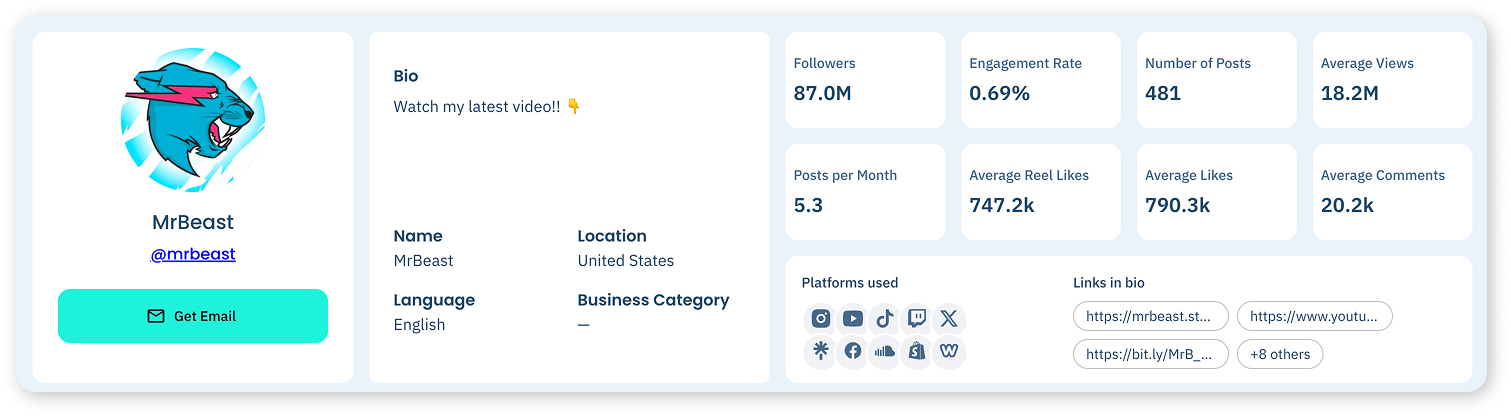
MrBeast
@mrbeast
Get EmailBio
Watch my latest video!! 👇
- Name
- MrBeast
- Location
- United States
- Language
- English
- Business Category
- Arts & Entertainment, Lifestyle
- Followers
- 88.9M
- Engagement Rate
- 2.23%
- Number of Posts
- 500
- Average Views
- 44.8M
- Posts per Month
- 5.3
- Average Reel Likes
- 1.6M
- Average Likes
- 4.1M
- Average Comments
- 59.5k
Platforms used
Links in bio
https://youtu.be/Af6i6ChAVTwEstimated Revenue
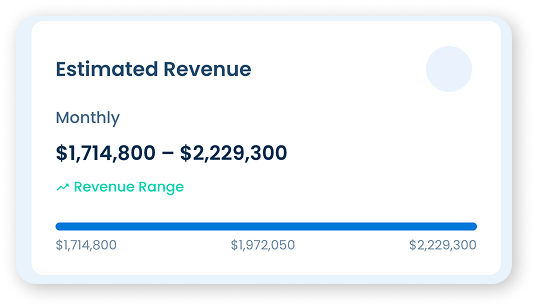
Monthly
$1,714,800 – $2,229,300
Revenue Range
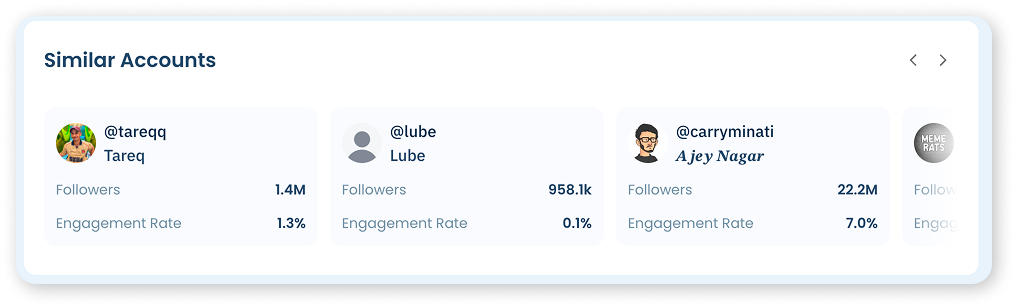
Similar Accounts

MrBeast Store
- Followers
- 1.4M
- Engagement Rate
- 0.36%

Chandler Hallow
- Followers
- 5.2M
- Engagement Rate
- 1.27%

Ava Tyson
- Followers
- 1.9M
- Engagement Rate
- 14.37%

PewDiePie
- Followers
- 19.4M
- Engagement Rate
- 7.09%

Lazar Beam
- Followers
- 2.8M
- Engagement Rate
- 7.90%

DramaAlert
- Followers
- 515.2k
- Engagement Rate
- 1.25%
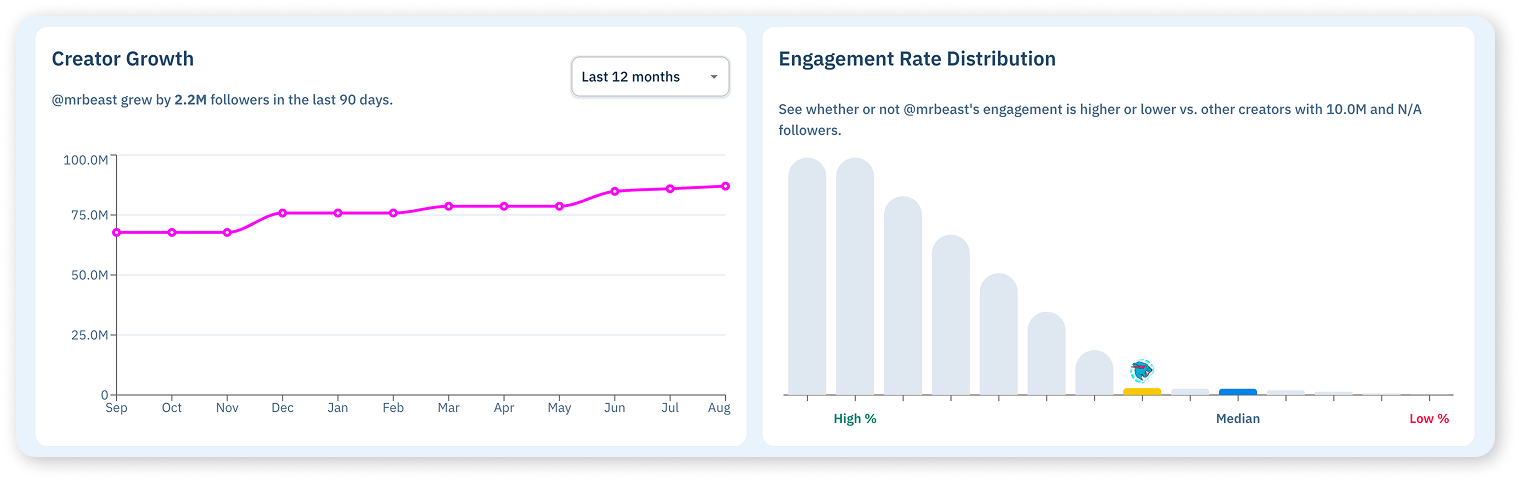
Creator Growth
@mrbeast grew by 2.2M followers in the last 90 days.
Engagement Rate Distribution
See whether or not @mrbeast's engagement is higher or lower vs. other creators in the same follower band.
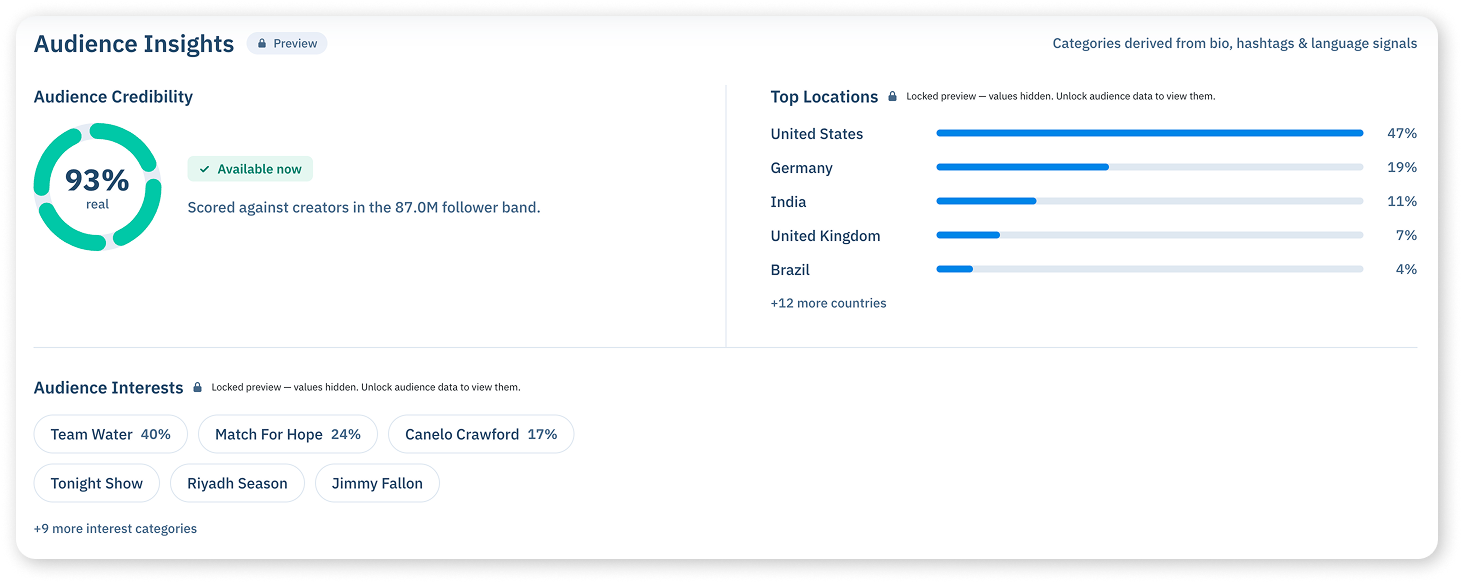
Audience Insights
Categories derived from bio, hashtags & language signals
Audience Credibility
Scored against creators in the 88.9M follower band.
Top Locations
+6 more countries
Age & Gender
Audience Interests
+20 more interest categories
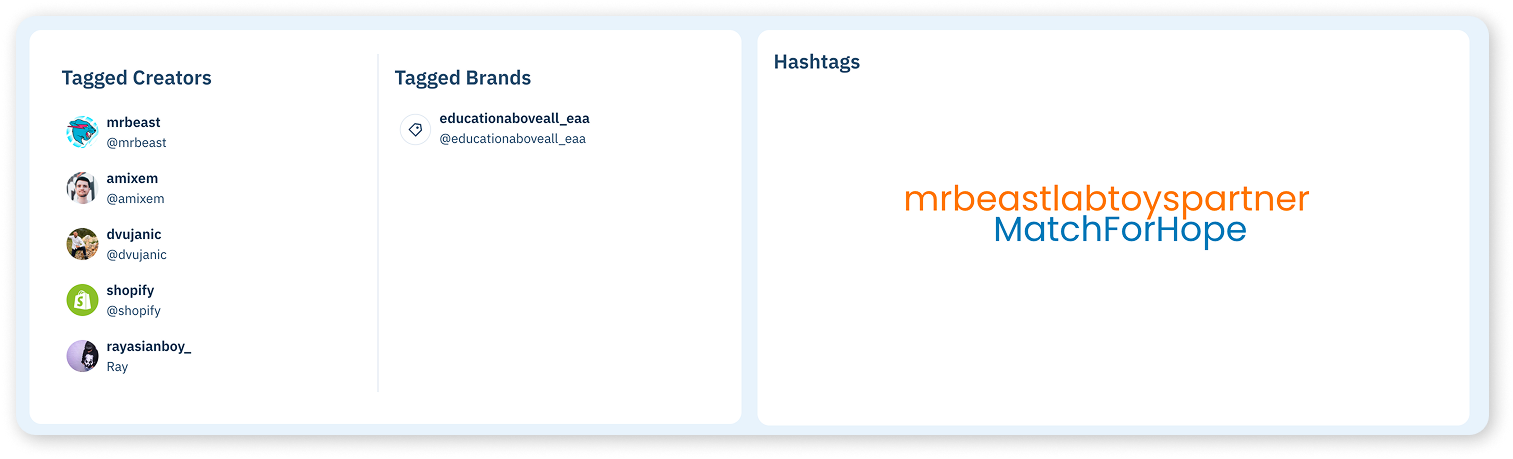
Tagged Creators
 thea
thea tareqq
 cristiano
 karljacobs
 nolanhansen
Tagged Brands
 boxbollen1 post(s)
 ishowspeed1 post(s)
 haleyybaylee1 post(s)
 cheetah1 post(s)
 derwinjames1 post(s)
Hashtags
Sample report shown for illustration. Run the tool above for a live report.
The basics
What is influencer analytics?
Influencer analytics is the practice of measuring a creator’s performance and audience with data instead of follower count. It answers three questions before you spend money on a partnership: does this creator’s content actually get engagement, is the audience real, and are those people your customers?
A follower count tells you almost nothing on its own. Two creators with 100,000 followers each can differ by 10x in the engagement they generate, and be selling to completely different audiences. Analytics is what separates the two.
Inside the report
What the analytics tool shows you
Every account the creator runs, in one view
Most tools analyze one handle on one platform. This one resolves the creator behind the handle and shows every account connected to them, with follower counts on each, so you can see the full footprint before you price anything. A creator with 87M on Instagram might have 504M subscribers on YouTube, and that changes the conversation.
Alongside it you get the identity layer: name, location, language, business category, public bio, every link in their bio, and their contact info. Matching runs against 340M+ creator profiles, with connected accounts tracked across 47 platforms, which is why the report finds channels a single platform search never surfaces.
- Linked accounts
- Followers per platform
- Public bio
- Links in bio
- Location
- Language
- Contact info

Engagement rate and performance metrics
Engagement rate is the headline number: total interactions divided by reach, shown as a percentage. It sits next to the metrics that give it meaning, so you can tell whether a rate comes from steady interest or from one post that ran away.
- Engagement rate
- Average views
- Average likes
- Average Reel likes
- Average comments
- Posts per month
- Total posts
(likes + comments) ÷ followers × 100
(likes + comments + shares) ÷ views × 100
Reel likes are split out from feed likes because the two behave differently. A creator whose Reels carry the account is a different buy than one whose feed does the work, and a blended average hides that.
Estimated revenue and rate context
The report puts an estimated monthly earnings range on the account, modeled from its public performance. It will not match what a creator quotes you, and it is not meant to. It gives you a defensible starting point for a negotiation instead of reacting to a number with nothing behind it.
Use it next to average views rather than follower count. Reach is what you are buying, so reach is what a rate should track.
Growth history and peer benchmarking
You get the follower curve over the last 12 months, plus how many followers the creator added in the last 90 days. A steady climb reads very differently from a vertical spike followed by a flat line. Sudden jumps without matching engagement are the clearest sign an audience was bought rather than built.
Next to it sits the engagement rate distribution, which places the creator against other accounts in the same follower band. This is the comparison that actually settles the “is 0.69% good” question, because it answers it for accounts of that size rather than in the abstract.
Audience insights and credibility
Follower count tells you how many. Audience insights tell you who. You get an audience credibility score, benchmarked against creators in the same follower band across the full 340M+ dataset, plus the top countries the audience sits in and the interest categories that come out of public bios, hashtags and language signals.
This is the difference between a creator who looks like a fit and one who is a fit. If you sell in Germany and 47% of the audience is in the US, the engagement rate stops mattering. Credibility and locations are the first two things to read, before anything else on the page.
- Audience credibility
- Top locations
- Audience interests
Brand history and hashtags
The report surfaces the brands and creators the account tags, and the hashtags it uses most. Together they tell you three things fast: who the creator has already worked with, whether they have promoted a competitor, and how often sponsored content shows up in the feed.
An account that tags a new brand every week is a different proposition to one that has run two partnerships in a year. Neither is wrong, but you should know which one you are talking to before you write the brief.
Similar accounts
Every report ends with creators who look like the one you searched, each with their follower count and engagement rate on the card. Matches are drawn from 340M+ profiles, so one handle you already like becomes a shortlist of candidates you had not heard of, which is usually where the good partnerships come from.
It is also the quickest way to sanity check a rate. If three comparable creators show double the engagement, you have a benchmark to negotiate against.
By platform
The metrics that matter shift by platform
The same handle means something different depending on where it publishes, so the analysis adjusts for each network.

Instagram influencer analytics
Engagement rate, Reel likes against feed likes, average views and audience credibility. Reach varies so much between formats that a single blended engagement number hides more than it shows.
Instagram audit tool
TikTok influencer analytics
TikTok runs on views, so a follower based engagement rate misleads. A creator with 20k followers can routinely pull a million views, which is why the analysis leads with average views and view based engagement.
TikTok analyzer
YouTube influencer analytics
Average views per video, view to subscriber ratio, comment volume and upload consistency. A channel with 200k subscribers and 4k average views is a very different buy than one with 50k subscribers and 40k views.
YouTube channel analyzerHow to use it
Analyze an influencer in three steps
-
Paste the handle
Pick the platform and drop in the username. No account, no credit card, no trial clock.
-
Read credibility and locations first
If the audience cannot buy from you, or a large share of it is not real, nothing else on the report is worth reading.
-
Check engagement against the follower band
Compare the rate to creators of the same size rather than to a generic benchmark, then look at the growth curve to see which direction it is heading.
Reading the report
Which influencer metrics actually matter
Not every number on a profile deserves equal weight. Ranked by how well each one predicts campaign outcomes.
| Metric | What it tells you | Why it matters |
|---|---|---|
| Audience location and language | Whether the audience can buy from you | Kills more deals than any other metric, and earliest |
| Audience credibility | How much of the following is real | A cheap CPM on a fake audience is not cheap |
| Engagement vs the follower band | Whether the rate is good for that size of account | Raw engagement rate means little without the peer comparison |
| Average views | Realistic reach per post | The number to price against, not followers |
| Growth pattern | Whether the audience was built or bought | Spikes without matching engagement are the tell |
| Follower count | The size of the list | The weakest predictor of results. Useful for pricing tiers, not selection |
The data
Where the numbers come from
Every profile analysis is built from publicly available information, collected and analyzed from public sources across the open internet, plus partners who provide publicly available data. Nothing behind a login.
Audience insights are modeled rather than reported. Interest categories are derived from public bios, hashtags and language signals, and the audience profile is built by analyzing a creator’s public engagers over time. The result is a well founded estimate rather than a copy of anyone’s private dashboard, which is also why it holds up consistently across creators of very different sizes.
The dataset behind the tool holds 340M+ creator profiles. Six platforms carry full profile and audience data (Instagram, TikTok, YouTube, X, Twitch and OnlyFans) and connected accounts are tracked across 47 in total. Profiles refresh weekly, and again whenever you export them.
The same data powers the Influencers.club dashboard and our API. This tool is a single profile window into it. Full sourcing and refresh detail sits on our data page.
Free tool vs account
What an account adds
The tool analyzes creators one at a time. An account turns the same data into a workflow.
| Capability | Free tool | Influencers.club account |
|---|---|---|
| Profile metrics, growth and revenue estimate | Yes | Yes |
| Connected accounts across 47 platforms | Yes | Yes |
| Full audience data: locations, interests, credibility | Locked preview | Full access |
| Search 340M+ creators with 40+ filters | Not included | Yes |
| Build and export lists with contact info | Not included | Yes, refreshed on export |
| Creators per session | One at a time | Bulk |
| API access | Not included | Pro plans |
Discovery, enrichment and tracking in one place
This tool reads one creator. An account gives you the rest of the workflow on the same data: discover creators across 340M+ profiles and six platforms with 40+ filters, enrich a list you already have with metrics, audience data and contact info, and track the creators you work with as their numbers move.
Every account starts with free credits, so you can run it on your own shortlist before you talk to anyone.
FAQ
Frequently asked questions
Is the influencer analytics tool free?
Yes. Paste a handle and the profile analysis runs with no signup, no trial and no credit card. Parts of the audience section show as a locked preview. Unlocking the full audience data takes an Influencers.club account, which starts with free credits, so you can open the rest of the report without paying anything either.
How do you calculate engagement rate?
Two ways. Engagement rate by followers is (likes + comments) ÷ followers × 100. Engagement rate by views is (likes + comments + shares) ÷ views × 100. We show the one that fits the platform, because a follower based rate on TikTok or YouTube Shorts routinely produces numbers that mean nothing.
What is a good engagement rate for an influencer?
It depends on the platform and the size of the account, and a single benchmark number is usually misleading. Smaller accounts almost always post higher rates than large ones. That is why the report shows an engagement rate distribution, placing the creator against other accounts in the same follower band, so you get the answer for that size rather than in the abstract.
Can I see every platform a creator is on?
Yes. The report resolves the creator behind the handle and lists the connected accounts we can match to them, with follower counts on each, plus the links in their bio. Six platforms carry full profile and audience data, being Instagram, TikTok, YouTube, X, Twitch and OnlyFans, and connected accounts are tracked across 47 platforms in total. That is often where the real reach turns up, since a creator’s largest audience is frequently not on the platform you searched.
How is estimated revenue calculated?
It is a model built on the account’s public performance, shown as a monthly range rather than a single figure. Treat it as a starting point for a rate conversation, not a quote. Creator pricing varies with deliverables, exclusivity and usage rights, none of which are visible from the outside.
Can I check if an influencer has fake followers?
The audience credibility score is the direct answer, and it is scored against creators in the same follower band rather than against everyone. Two supporting signals are worth reading with it: a vertical jump in the follower curve without a matching rise in engagement, and an engagement rate far below normal for that account size.
Where do the audience demographics come from?
They are modeled from public data, not taken from a creator’s own analytics. Interest categories are derived from public bios, hashtags and language signals, and the audience profile is built by analyzing a creator’s public engagers over time and extrapolating statistically.
Can I see which brands a creator has worked with?
The report shows the brands and creators the account tags, along with the hashtags it uses most. That gives you a picture of past partnerships, whether a competitor has already run with them, and how often sponsored content appears.
Can I find influencers similar to the one I searched?
Yes. Every report includes similar accounts with follower counts and engagement rates, so one creator you like turns into a shortlist. Matches come from a dataset of 340M+ creator profiles. For a full search with 40+ filters, use the influencer search tool.
Can I analyze a private profile?
No. The tool only works on public profiles. If an account is private there is no public data to analyze, and you will get a message telling you so.
How accurate is the data?
Profile stats and post performance come from public data and track the creator’s public profile. Audience insights and estimated revenue are statistical models, accurate at the level you would actually use them, such as whether an audience is mostly US or mostly real, rather than to the individual follower or the exact dollar.
How many creators are in the database?
340M+ creator profiles. Six platforms carry full profile and audience data, being Instagram, TikTok, YouTube, X, Twitch and OnlyFans, and connected accounts are tracked across 47 platforms in total. Profiles refresh weekly, and again whenever you export them.
What do I get if I create an account?
Three things the free tool does not do. Discovery: search all 340M+ creators across six platforms with 40+ filters instead of analyzing one handle at a time. Enrichment: full audience data rather than the locked preview, plus list exports with contact info refreshed at the point of export. Tracking: monitor the creators you work with as their metrics move. Sign up is self serve and starts with free credits, and API access comes with Pro plans.
Can I get this data through an API?
Yes. Everything in this report is available through the Influencers.club API as structured JSON, across 19 documented endpoint groups covering discovery, profile metrics, audience data, contact info and creator tracking. Onboarding is self serve with free credits, so you can build against it without a sales call. API access comes with Pro plans.
How is this different from the influencer search tool?
This tool analyzes one creator you already know about. The search tool finds creators you do not, letting you filter 340M+ profiles by audience demographics, engagement, niche and location, then analyze the ones worth a closer look.