
 VG
VG
The problem: identity is fragmented across platforms
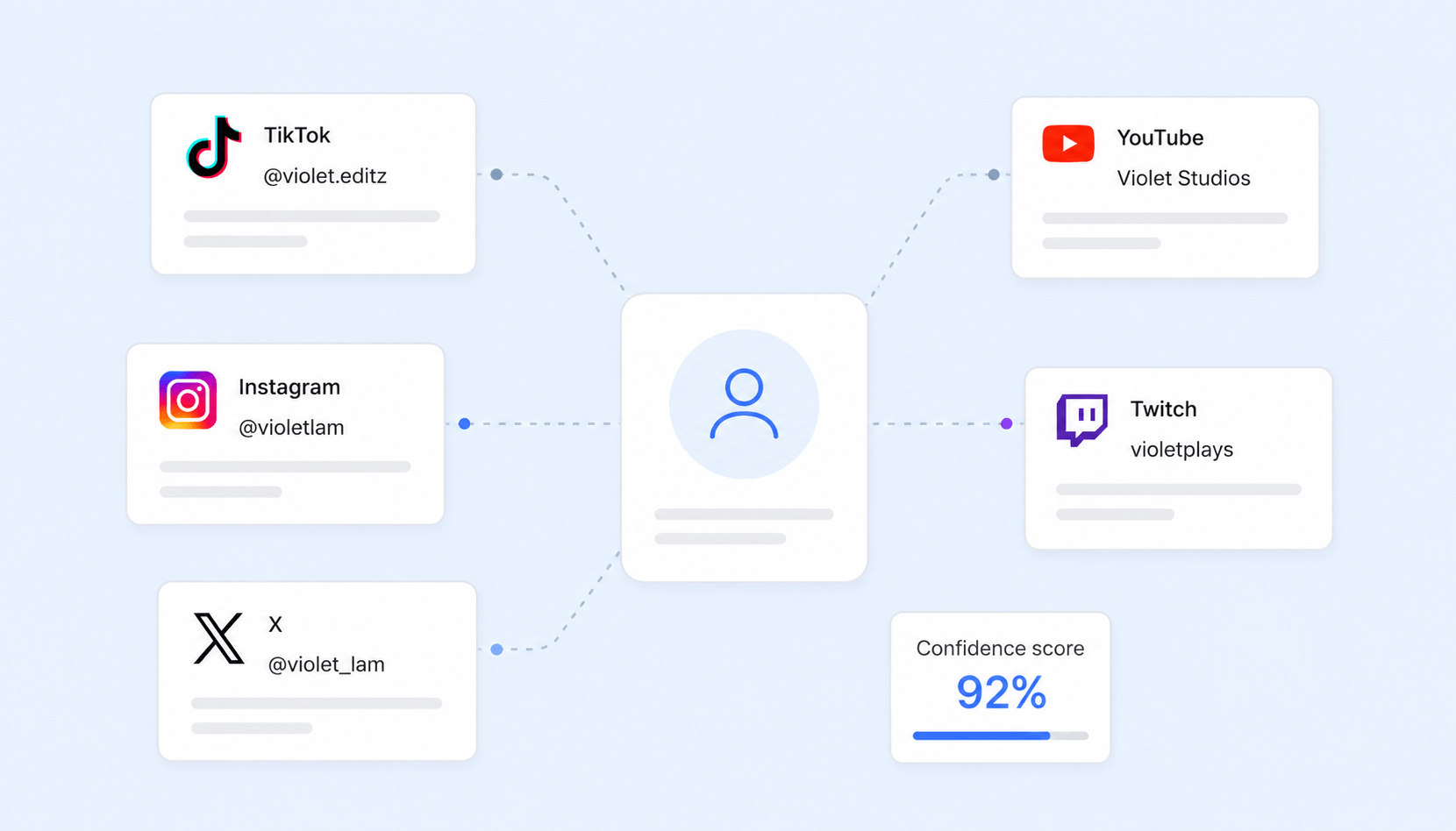
Matching accounts by username alone breaks immediately. Naming conventions diverge so often between platforms that an exact handle match is weak evidence, not strong. Meanwhile the cases that look easiest are often traps: a fan page links to a creator’s real profile, two collaborators cross-link constantly, and a single creator may run several legitimate channels on the same platform.
A naive matcher fails in both directions — false positives (a fan page matched as the creator) and false negatives (a differently-named channel that genuinely belongs to them, missed). At 130M profiles across 9 platforms, neither error is acceptable, and neither is something a single heuristic can solve.
No single signal is trusted alone.
We needed a system that combines intentional connection signals — the links creators place themselves — with profile-level similarity, scores its own confidence, and routes the ambiguous cases to people.
The approach
The pipeline has three layers, each chosen to compensate for the others’ blind spots:
- A weighted link graph as the primary signal.Links a creator deliberately places — in a public bio, a Linktree, a contact form — are the strongest evidence of identity because they’re intentional. We model these as a directed, weighted graph rather than simple pairwise rules, so indirect connections still carry signal.
- Profile feature similarity as corroboration.Usernames, profile images, and public bio text catch real matches the link graph misses — and, just as importantly, contradict false ones.
- Human-in-the-loop review as ground truth.Algorithmic scores are calibrated against manually reviewed pairs, and that labeled data is what now feeds our ML layer.
The ordering matters: links propose, features corroborate, humans adjudicate the edge cases.
1Link acquisition
We collect the links creators publish themselves, weighted by how intentional each source is. We only use publicly available links that creators have placed on their own profiles:
- Public bio sectionsInstagram, TikTok, X, YouTube descriptions — primary, high-intent cross-promotion.
- Centralized link platforms and contact formsLinktree-style hubs and site contact pages — the most curated signal a creator gives us.
- Caption contentLower intentionality, treated as supporting evidence.
Every source we add is a place a creator chose to list their own platforms.
2Building the weighted graph
Each profile is a node; each discovered link is a directed edge from the source platform to the one it points to. Edge weight encodes inferred intent — curated hubs and bio links weigh more than caption mentions, and when the same link appears across multiple sources we raise its weight. A connection seen in three places is stronger than one seen once.
Directionality is preserved throughout: A→B is a different fact from B→A, and that asymmetry helps distinguish creators from accounts that merely point at them.
3Mapping clusters before scoring pairs
We group the link graph into clusters: each cluster is a set of profiles connected to one another — directly or through intermediate links — a candidate “this is one creator.” We then evaluate one cluster at a time, and the cluster shapes everything that follows in two ways.
First, we only ever weigh profiles that already sit in the same cluster, so the system never proposes a match between people who share no connection at all. Second, not every cluster deserves equal trust — and the riskiest are the largest. A handful of heavily cross-linked hubs, link directories, or viral collaboration webs can sweep thousands of unrelated profiles into one group. We isolate clusters that grow beyond a healthy size and hold them back from automatic matching rather than risk fusing strangers into one identity.
That last case — a creator with a main channel and a second channel — is one we handle explicitly, using content style and linking patterns to tell legitimate multi-channel setups apart from two different people who happen to cross-link.
4Scoring each pair
Within a cluster, every candidate pairing gets a confidence score from 0 to 1 and the reason behind it. We work in layers: the strongest, simplest evidence is checked first, and we only reach for deeper comparison when that isn’t conclusive.
The strongest signal is mutual intent — when two profiles deliberately point to each other, that two-way link is powerful evidence of one identity. Past that, the kind of connection sets the bar: a link the creator placed themselves can confirm identity on lighter evidence, while a link we inferred doesn’t carry that shortcut alone — it’s far from ignored, just de-ranked appropriately.
Every pair ends with a score and the reason behind it — an internal log that guides human review and lets us constantly improve the accuracy of the algorithm.
5Feature-based corroboration
Link evidence is then checked against the profiles themselves:
- Username similarityPlatform-aware fuzzy matching — an exact match between platforms with inconsistent naming conventions counts for less than one between platforms where handles are usually consistent.
- Image similarityPerceptual hashing of avatars and logos to catch consistent visual branding across a creator’s profiles.
- Public bio and caption textSemantic similarity to find shared keywords, brand language, and tone consistency across platforms. Posting frequency is considered but discounted, since cadence varies wildly by platform.
- Outlier detectionThe system flags accounts that link in but differ in content and audience profile, so fan pages and collaborators don’t get absorbed into a creator’s identity.
6Human review and the feedback loop
We sample both high- and low-scoring pairs for manual review to catch false positives and false negatives. Error patterns from that review drive iterative adjustment of weights and thresholds — and, increasingly, train a model. Confirmed positive and negative matches from review are the labeled dataset behind our ML layer, which is learning to surface subtle patterns the hand-tuned rules miss.
What we’d flag honestly
A few things we made peace with, and a few we’re still improving:
- The graph rewards what creators bother to link.Creators who don’t maintain a link hub or cross-promote are under-connected in the graph and lean harder on feature similarity, where confidence is lower. Coverage isn’t uniform across creator types, and we’re honest about that internally.
- Reciprocal-link bias.Weighting reciprocal links heavily is correct most of the time, but it under-scores legitimate one-directional setups — a creator who links Instagram→YouTube but never back. We treat a strong one-way link plus feature corroboration as comparable to a weak reciprocal one.
- Same-platform duplicates remain the hardest case.Telling a creator’s second channel apart from a different person is where most of our remaining manual review time goes.
The result
| Metric | Value |
|---|---|
| Platforms linked | 9 — Instagram, X, YouTube, LinkedIn, Linktree, OnlyFans, Snapchat, TikTok, Twitch |
| Profiles in graph | 130M total · 70M handles tied to creators · 16M unique creators |
| Match precision | 98% across 24k human-reviewed pairs |
The core idea that makes this work: no single signal is trusted alone. Links propose connections, profile features corroborate or contradict them, cluster context calibrates confidence, and humans adjudicate the rest — with every human decision feeding back into the model. That layering is what lets us hand a brand a match and a confidence score they can act on.
Build on the creator data layer
340M+ creators, multi-platform data, 200+ insights via API, dashboard or MCP server.
More from engineering
All articles →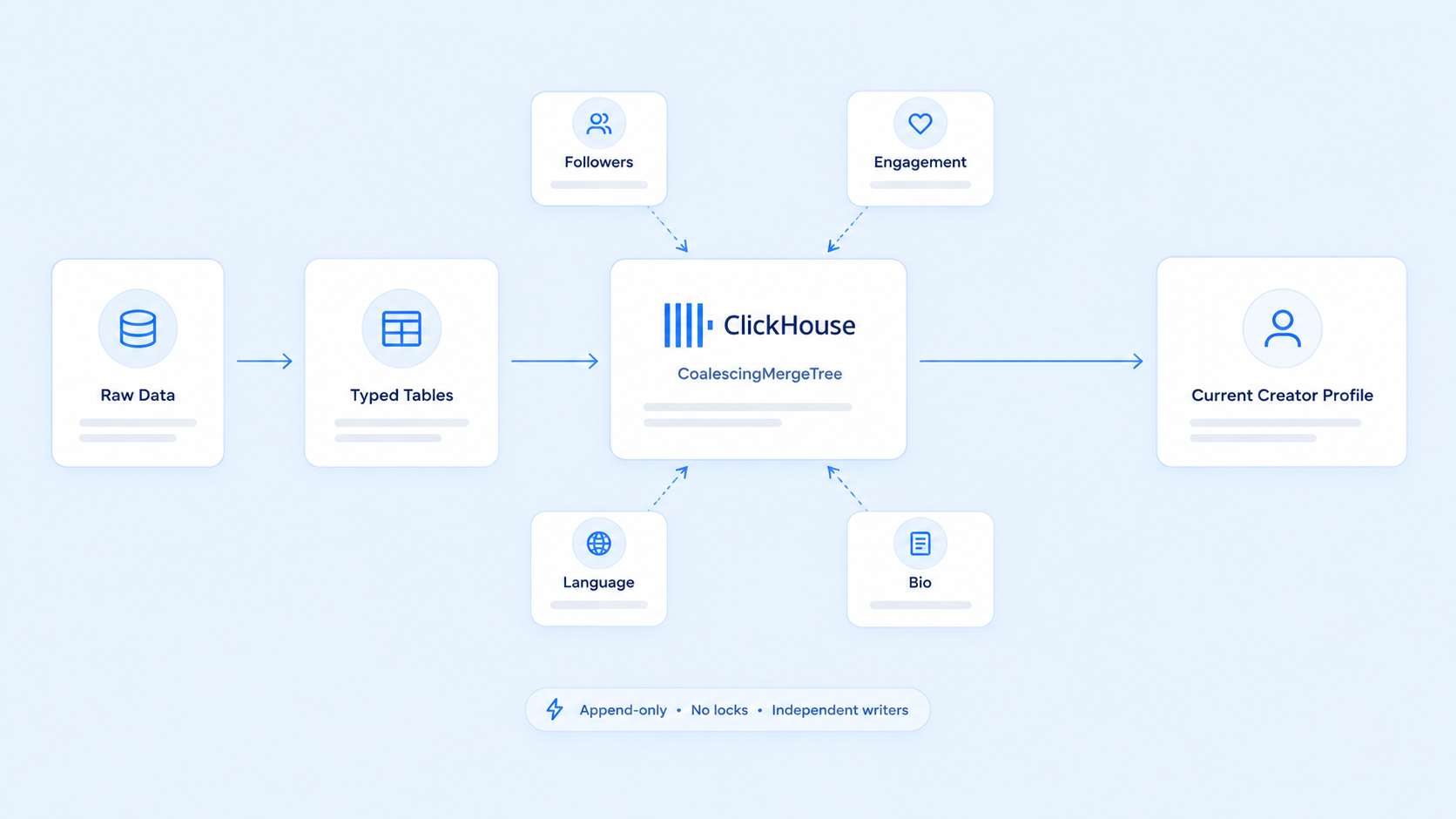
Unlocking our data processing with ClickHouse
How dropping one assumption — that a profile is a single record — turned upserts and a monolith into append-only writes and isolated datapoints.
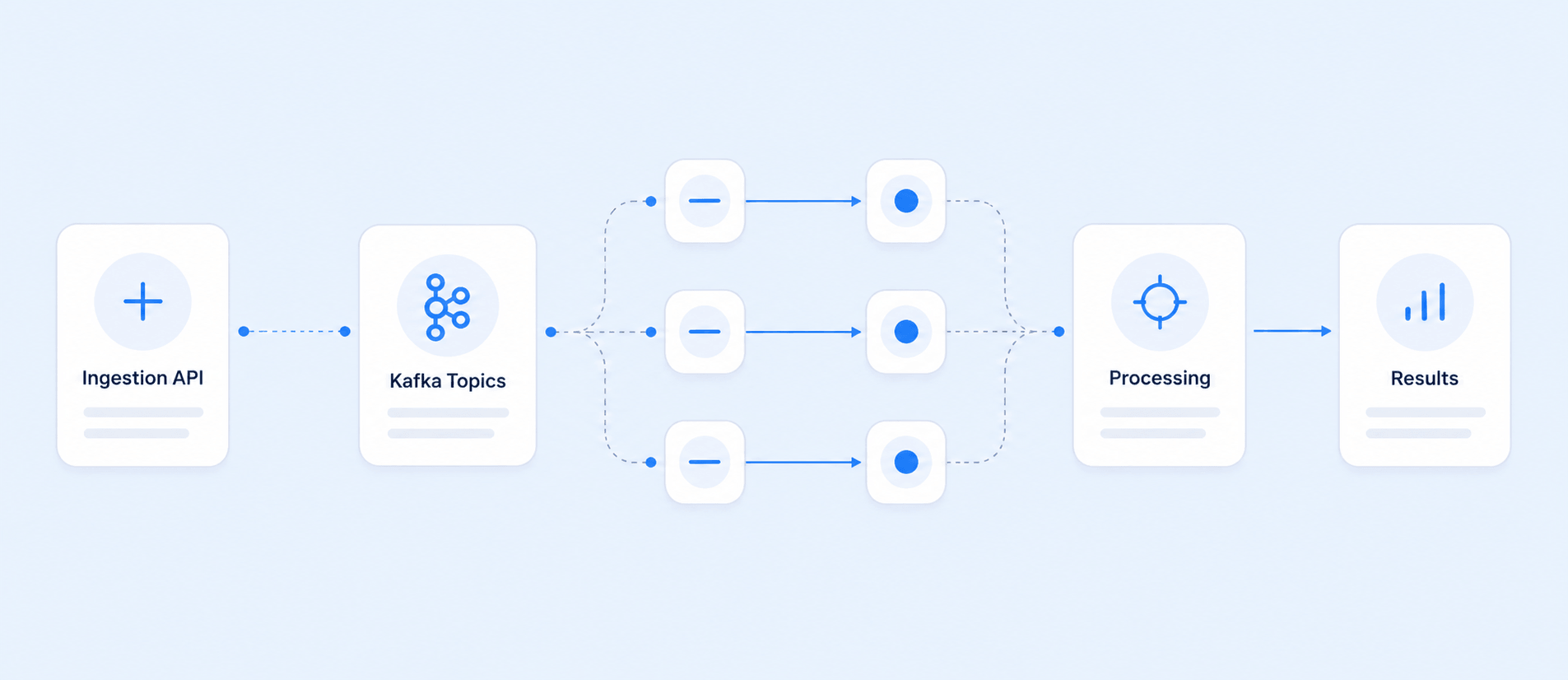
Rebuilding our pipeline for 13x throughput on Kafka and Prefect
Why one-at-a-time processing fell over, what replaced it, and how a 100k-creator batch went from 13 hours to one.