
Free Earned Media Value (EMV) Calculator
Get EMV and projected metrics and engagement for your influencer campaigns. No signup.
The breakdown uses the same rates and rounding as the calculator above.
Example EMV calculation: one Cristiano Ronaldo reel on Instagram
$653,500
estimated media value · 1 reel

Cristiano Ronaldo
| How we got there | avg per reel | Rate | Value |
|---|---|---|---|
| Views | 52,205,590 | × $0.0052 | $271,469 |
| Likes | 1,802,615 | × $0.18 | $324,471 |
| Comments | 67,722 | × $0.85 | $57,563 |
| Shares — available in the dashboard | |||
| Subtotal | $653,503 | ||
| Instagram rate adjustment | × 1.00 | ||
| Rounded to the nearest $100 | $653,500 |
Example shown for illustration. Enter any creator in the calculator above for a live estimate.
Track EMV across a whole campaignThe basics
What is earned media value?
Earned media value (EMV) is the dollar value of the attention an influencer post generates, worked out from the interactions it gets. Each view, like, comment and share is assigned a rate, the rates are added up, and the total is what you would have had to spend on paid media to buy the same amount of attention. It turns “this post did well” into a number a budget can be compared against.
Two creators can charge the same fee for a Reel. One reliably pulls 40,000 views and 300 comments; the other pulls 6,000 views and a handful of likes. The invoices look identical. EMV does not, which is why brands and agencies use it to compare creators before a campaign, price partnerships, and report what a campaign actually returned.
(views × rate) + (likes × rate) + (comments × rate) + (shares × rate)
× platform adjustment × content quality
Each interaction type has its own rate. Comments and shares are worth several times a like or a view, because someone who typed a reply or passed the post on did something that a scroll-past never does.
Σ (EMV per post × number of posts) across every creator
A campaign is a list of creators, each publishing some mix of formats. The calculator values each format for each creator, multiplies by how many posts you have agreed, and adds it all up. Add your spend and you get EMV against what you paid.
Inside the result
What the EMV calculator shows you
A single dollar figure is only useful if you can see how it was built. The calculator returns the number with every line that produced it.
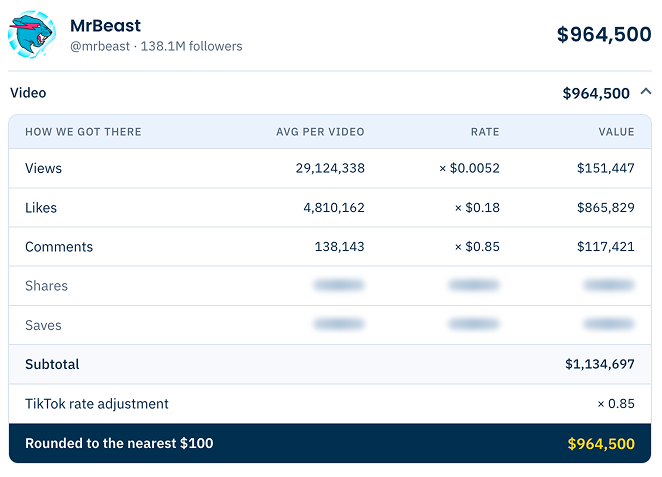
The value of a post, with the full working
Paste a handle, pick a format, and you get the estimated media value of one post from that creator, built from their average interactions on recent publicly available content rather than from a single outlier. Open “How we got there” and every line is on the table: the average count per interaction type, the rate applied to each, the subtotal, the platform adjustment and the content quality factor, rounded to the nearest $100.
- EMV per post
- Average views
- Average likes
- Average comments
- Average shares
- Rate per interaction
- Platform adjustment
- Content quality
Where a format does not produce a metric, such as views on an Instagram feed post, that line is marked and left out rather than guessed.
Campaign totals across creators and formats
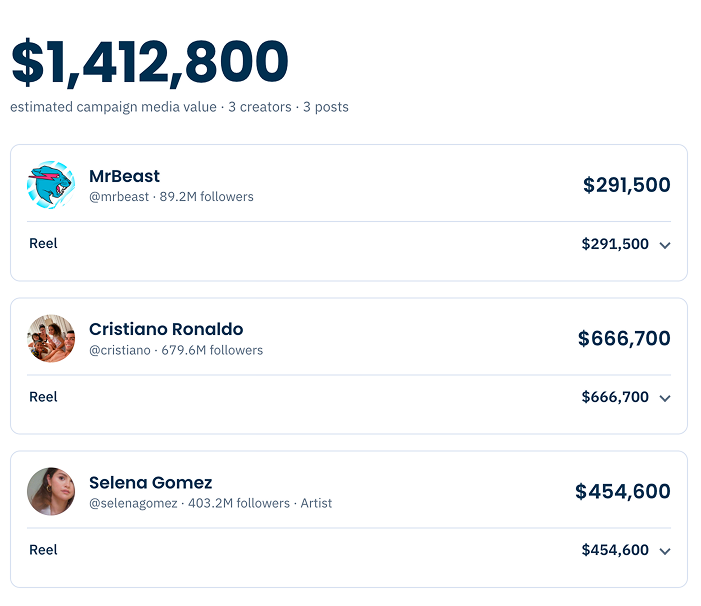
Add up to three creators, give each the mix of formats you have agreed with them, set how many posts of each, and the calculator returns the campaign total with a per-creator subtotal underneath. Reels and feed posts on Instagram, videos on TikTok, videos and Shorts on YouTube, each valued with its own numbers because a Short and a long-form video from the same channel do not earn the same.
A creator whose Reel is worth $1,200 might be worth $300 on a feed post. Pricing the deliverables separately is how you find out where the budget is actually working.
EMV against what you are paying
Type in the total campaign spend and the result adds the EMV-to-spend ratio, which is the number most reports are actually built around. A campaign that costs $5,000 and produces $12,000 of estimated media value has a 2.4× return on paid-equivalent attention; the same spend at $3,000 EMV is a conversation to have before you sign, not after.
Because every creator is valued separately, the ratio also tells you which creator on the list is carrying the campaign and which one is being paid for their follower count.

By platform
How EMV is calculated on each platform
A view on YouTube is not a view on TikTok, and the formats within one platform behave differently again. The calculator applies rates and an adjustment that fit the platform and format you pick.

Instagram EMV
Reels: views, likes, comments, shares
Feed posts: likes, comments, shares
Reels are valued on plays plus interactions, feed posts on interactions alone, since plays are not a feed metric. Reel likes are read separately from feed likes, because a blended average hides which format carries the account. Instagram is the baseline for the platform adjustment.
Track Instagram campaigns
TikTok EMV
Videos: views, likes, comments, shares
TikTok produces large view counts from the algorithm rather than the follower list, so views and likes carry a lower rate than on Instagram and the platform adjustment sits slightly below baseline. Shares keep a high rate everywhere, because a share is what drives further distribution.
Track TikTok campaigns
YouTube EMV
Videos: views, likes, comments, shares
Shorts: views, likes, comments, shares
A YouTube view is a deliberate watch, often of several minutes, so views, likes and comments carry the highest rates of the three and the platform adjustment sits above baseline. Shorts are valued on their own averages, not the channel’s long-form numbers.
Track YouTube campaignsOn every platform the subtotal is then multiplied by a content quality factor: the creator’s engagement rate against what is typical for accounts of the same size, capped so that one unusual month cannot swing the value more than a quarter either way. A creator whose audience engages more than their peers earns above the rate card; one whose audience is quiet earns below it.
Benchmarks
What is a good EMV?
There is no good EMV in the abstract, only a good EMV for what you paid and what you were trying to get. Three things decide how to read it.
EMV against spend
The ratio is the number that matters. Most teams treat anything comfortably above 1× as a campaign that earned more attention than it bought, and use the ratio to compare campaigns of different sizes on equal terms. A $2,000 campaign at 3× beat a $20,000 campaign at 1.1×.
Add your spend to the result and compare ratios, not totals.
Per post, not per creator
A creator with a high total EMV may simply have been booked for more posts. The per-post figure, and the per-format figure inside it, is what tells you whether the fee is fair. Two Reels at $600 each and one at $2,400 are the same total and very different deals.
Negotiate on the per-post value; report on the total.
Estimate, then actual
Before a campaign, EMV is a forecast built from what a creator’s recent content typically earns. After launch, the real posts either confirm it or not. A creator who forecast $1,500 and delivered $400 is a data point for the next brief.
Forecast here, then track the actual posts as they land.
How to use it
Calculate the EMV of an influencer campaign in three steps
-
Pick the platform and add the creators
Instagram, TikTok or YouTube. Paste up to three handles. No account, no credit card, five free lookups a day.
-
Set the deliverables
For each creator, choose the formats you have agreed and how many of each: two Reels and a feed post, three TikToks, one video and four Shorts.
-
Read the total, then open the working
Check the campaign total, then expand each format to see which interactions drove it. Add your spend to get the ratio you will be asked for.
After the estimate
Track the real EMV of every post as it goes live
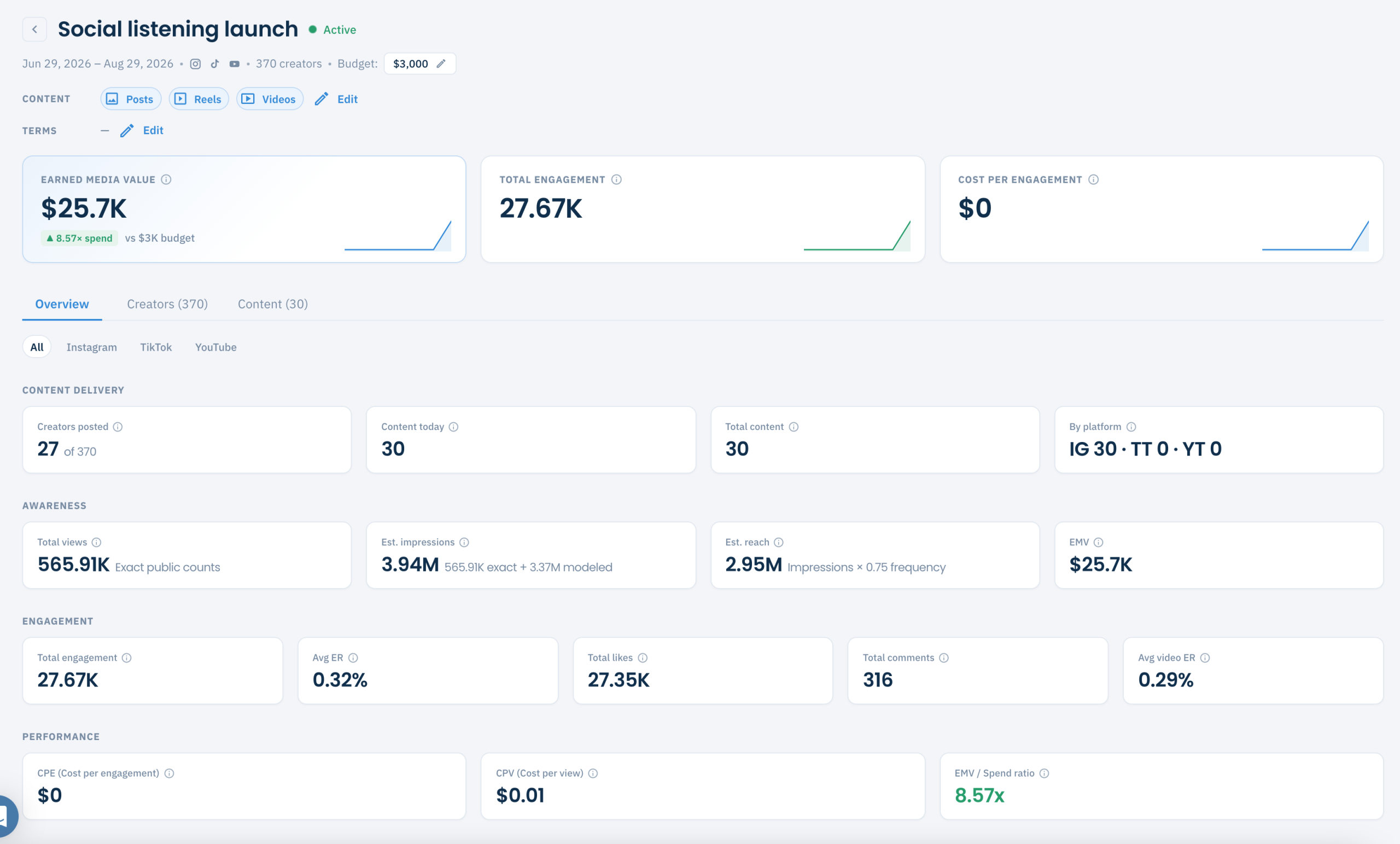
The calculator forecasts what a campaign should earn. Campaign tracking measures what it actually did, for every creator on the list, without anyone sending screenshots.
From three creators to the whole roster
Add every creator in the campaign from a saved list, pasted handles or a CSV. Each publicly available post they publish is picked up automatically, usually within about an hour, and scored on the same basis as the calculator: earned media value, engagement rate, views, estimated reach and comment sentiment.
- No three-creator cap and no daily lookup limit
- EMV per post, per creator and per campaign, updated as posts land
- Add a budget for cost per engagement, cost per view and EMV against spend
- An editable AI report that exports to Google Docs or Word
- The same data over the API and webhooks, delivered to your own endpoint
Reading the number
Five ways EMV gets misread
The arithmetic is simple. The mistakes come from what gets counted, what gets compared, and what the number is asked to prove.
-
Treating EMV as revenue
EMV is the paid-media cost of equivalent attention, not money that arrived. It tells you how much exposure a campaign earned relative to what it cost, and it should sit next to sales and conversion data, not in place of it.
-
Valuing a view the same on every platform
A YouTube view is a deliberate watch; a TikTok view can be a half-second before a swipe. Calculators that apply one rate to every view overstate short-form and understate long-form. The rates and the platform adjustment exist to correct for this.
-
Building it from one post
A giveaway or a viral clip can triple a creator’s normal numbers. A forecast built on that post is a forecast of the exception. Value on the average of recent content, and check the spread.
-
Comparing EMV from different calculators
Every EMV model uses its own rate card, so $8,000 from one tool and $5,000 from another are not a disagreement about the creator, they are a disagreement about the rates. Use one model across every creator you compare, and pick one that shows its rates.
-
Ignoring who is engaging
Purchased interactions and engagement pods inflate EMV just as they inflate engagement rate. The content quality factor pulls the value down for accounts engaging below their peers, but it is not a substitute for checking audience credibility on the analytics tool first.
Free tool vs account
What an account adds
The calculator estimates a campaign before it runs. An account measures it while it runs and turns the same data into a workflow.
| Capability | Free calculator | Influencers.club account |
|---|---|---|
| EMV per post with the full formula shown | Yes | Yes |
| Creators per calculation | Up to 3 | Every creator in the campaign |
| Lookups per day | 5 | Credit based, starts free |
| EMV of real posts as they go live | Forecast only | Tracked automatically |
| Engagement rate, reach and comment sentiment per post | Not included | Yes |
| Cost per engagement, cost per view, EMV to spend | EMV to spend only | All three, per campaign |
| Editable AI campaign report | Not included | Exports to Google Docs or Word |
| Find creators to add by engagement, size and niche | Not included | Search 340M+ profiles with 40+ filters |
| API and webhooks | Not included | Yes |
Stop estimating campaign value. Start measuring it.
The calculator tells you what a campaign should be worth. An account tracks every creator on it, scores each post the moment it lands, and turns the numbers into a report you can hand to a client or a CFO.
Every account starts with free credits, so you can track your next campaign before you talk to anyone.
FAQ
Frequently asked questions
Is the EMV calculator free?
Yes. Pick a platform, paste up to three handles, set the posts you have agreed with each creator and the estimated media value appears with the full working, no signup and no credit card. You get five free lookups a day, and each creator uses one. Tracking more creators, or tracking a live campaign, takes an Influencers.club account, which starts with free credits.
What is earned media value in influencer marketing?
Earned media value is the estimated cost of buying, through paid media, the same amount of attention an influencer post generated organically. It is calculated by assigning a dollar rate to each view, like, comment and share the post earns and adding them up. Brands and agencies use it to compare creators, price partnerships and report campaign performance in a currency a budget owner understands.
How do you calculate EMV?
For one post: take the creator’s average interactions on recent content, multiply each interaction type by its rate, and add the results. Comments and shares carry higher rates than likes and views. The subtotal is multiplied by a platform adjustment, since a YouTube view and a TikTok view are not worth the same, and by a content quality factor that compares the creator’s engagement rate with what is typical for accounts of the same size. The result is rounded to the nearest $100. For a campaign, multiply each creator’s per-post value by the number of posts and add across all creators.
How do I calculate EMV manually?
Take the creator’s last ten or so posts in the format you are buying and average the views, likes, comments and shares. Multiply each average by a rate for that interaction type, add them up, and adjust for the platform. Then multiply by the number of posts. The calculator does this for you and shows every line, so you can check the rate it applied to each interaction and reproduce the number.
What is a good EMV?
On its own, EMV has no good or bad. Divided by what you spent it does. An EMV-to-spend ratio above 1× means the campaign earned more attention than the paid-media equivalent would have cost, and most teams compare campaigns of different sizes on that ratio rather than on totals. Add your spend to the result and the calculator gives you the ratio directly.
What is the EMV of an Instagram post?
It depends on the format. A Reel is valued on plays, likes, comments and shares; a feed post on likes, comments and shares, since plays are not a feed metric. The calculator reads Reel likes separately from feed likes because the two formats perform differently on the same account, and Instagram is the baseline for the platform adjustment. Stories are not included.
What is the EMV of a TikTok video?
TikTok EMV is built from views, likes, comments and shares on the creator’s recent videos. Because TikTok’s algorithm produces large view counts that have little to do with the follower list, views and likes carry a lower rate than on Instagram and the platform adjustment sits slightly below baseline. Shares keep a high rate, as they are what pushes a video further.
What is the EMV of a YouTube video or Short?
YouTube carries the highest per-interaction rates of the three platforms and a platform adjustment above baseline, because a YouTube view is a deliberate watch rather than a scroll. Videos and Shorts are valued separately on their own averages, so a channel’s long-form numbers do not inflate the value of a Short.
What is the difference between EMV and engagement rate?
Engagement rate is a percentage: interactions divided by the audience that could have seen the post. It tells you how attentive an audience is. EMV is a dollar figure: the interactions multiplied by what each is worth. It tells you how much attention was generated. A small account can have a high engagement rate and a low EMV. The calculator uses the creator’s engagement rate as the content quality factor inside the EMV, and the engagement rate calculator shows the rate on its own.
Is EMV the same as what I should pay a creator?
No. EMV is the paid-media cost of equivalent attention, not a rate card. Creators price on reach, production effort, exclusivity and usage rights, and a fair fee is usually a fraction of the EMV a post is expected to earn. What EMV does give you is a consistent way to compare two creators quoting the same fee, and a ratio to judge the deal by afterwards.
Why is my EMV different from other calculators?
Every EMV model uses its own rate per interaction, and many apply one rate to every view regardless of platform. A different rate card produces a different number for the same creator. This calculator shows the rate applied to each interaction, the platform adjustment and the quality factor, so the result is reproducible and you can see exactly where two tools diverge. The comparison that matters is between creators valued on the same model, not between models.
Can I calculate EMV for Instagram Stories?
No. The calculator values Reels and feed posts on Instagram. Stories expire and their performance is not part of a creator’s public profile, so there is nothing to build an estimate from.
Can I calculate EMV for a private profile?
No. The calculator works from publicly available profiles and content. If an account is private there is no public data to value, and the result will tell you the profile could not be found.
How many creators can I add?
Up to three per calculation, with as many post formats and post counts as you like for each. Five free lookups a day, one per creator. For a campaign with more creators than that, an Influencers.club account tracks the whole roster, with no per-calculation cap and posts scored automatically as they go live. Accounts start with free credits.
Can I track the EMV of a live campaign?
Yes, with an account. Campaign tracking picks up every publicly available post your creators publish on Instagram, TikTok and YouTube, usually within about an hour, and scores each one for earned media value, engagement rate, views, estimated reach and comment sentiment. Add a budget and you get cost per engagement, cost per view and EMV against spend per campaign, plus an editable AI report that exports to Google Docs or Word.
Can I get EMV through an API?
Yes. Campaign tracking runs over the Influencers.club API: subscribe to the creators you care about and receive structured events at your own endpoint when they post, with delivery history and automatic retries. Campaign metrics, including EMV, are available through the campaigns endpoints. Onboarding is self serve with free credits.
How is this different from the influencer analytics tool?
The EMV calculator answers one question: what is a post or a campaign from these creators worth. The influencer analytics tool runs the full profile report on a single creator: growth history, audience credibility, top locations, interests, tagged brands and similar accounts. Use the analytics tool to decide whether a creator is worth booking; use the calculator to decide what the booking is worth.